
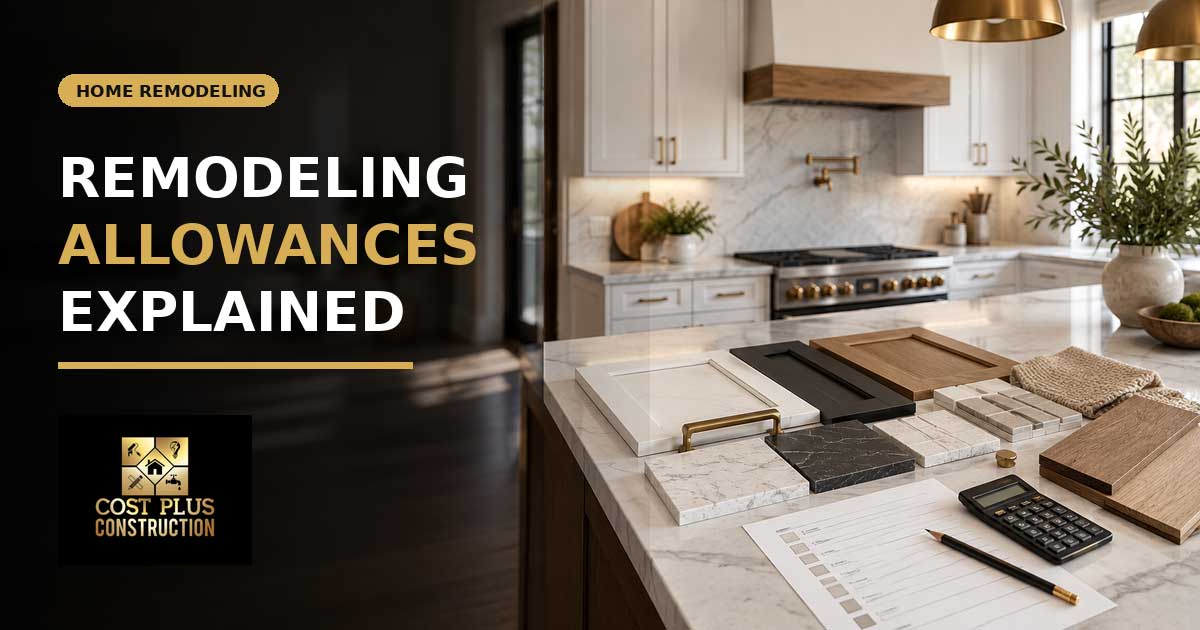
Remodeling Allowances Explained How to Avoid Budget Surprises
A practical guide to setting tracking and approving allowances before your Houston area remodel begins
A remodeling allowance is a placeholder amount in the project budget for an item that has not been selected or fully priced when the agreement is prepared. Common allowance categories include cabinets, countertops, tile, flooring, plumbing fixtures, lighting, appliances, hardware, and finish materials.
An allowance is not a guaranteed final price. If the actual approved selection costs more than the allowance, the project cost increases. If it costs less, the customer should receive the benefit according to the contract and pricing method. The safest allowance is specific, realistic, and clear about what is included.
Why Contractors Use Allowances
Homeowners do not always have every finish selected before they are ready to plan the project. An allowance lets the contractor build a working budget while giving the customer time to choose an exact product.
Allowances can be useful, but they should not be used to make a proposal look artificially low. If a realistic vanity package is likely to include the cabinet, top, sink, hardware, delivery, and tax, a vague allowance that covers only the cabinet creates a misleading comparison.
Related service: complete turn-key renovations.
What a Good Allowance Should Identify
Each allowance should name the category, dollar amount, quantity or area, expected quality level, and who is responsible for making and purchasing the selection. It should also state whether the allowance includes sales tax, delivery, freight, waste, accessories, installation labor, and the contractor fee.
For tile, for example, the budget should distinguish the material allowance per square foot from the labor required for the planned pattern and surface. A large-format tile, mosaic, herringbone layout, specialty edge, or natural stone may affect labor even when the material price is similar.
Material Cost and Installed Cost Are Different
The shelf price is only one part of a selection. An installed cost may also include tax, delivery, handling, setting materials, fasteners, trim pieces, underlayment, fabrication, equipment, waste, and labor.
A homeowner who compares a retail product price with a complete installed allowance may think the allowance is high when it actually includes more. The reverse can also happen. A material-only allowance may look generous until the missing components are added. Ask for the basis of every important number.
Seven Steps to Control Allowances Before Work Starts
1 Make key selections early
Select anything that affects layout, rough plumbing, wiring, ventilation, cabinet dimensions, lead time, or installation method before demolition whenever possible.
2 Compare allowances line by line
Do not compare only total proposal prices. One bid may include realistic finish budgets while another uses low placeholders or excludes delivery and installation.
3 Ask what each amount includes
Confirm whether tax, freight, waste, accessories, fabrication, installation, and the contractor fee are inside or outside the allowance.
4 Tie the allowance to quantity
A dollar amount is more useful when it also states square footage, fixture count, cabinet layout, countertop area, or another measurable basis.
5 Set selection deadlines
Late selections can delay ordering, rough work, fabrication, and installation. Put decision dates on the project schedule and verify availability before approval.
6 Approve changes in writing
Record the selected product, actual cost, allowance credit, net difference, fee treatment, tax, schedule effect, and approval before ordering.
7 Keep a contingency separate
Allowances cover unfinished selections. A contingency is a separate reserve for reasonable unknowns or approved changes. Combining them makes the budget harder to understand.
How Allowances Work in a Cost Plus Project
In a properly administered cost-plus project, the customer can see actual project costs and the agreed contractor fee. That visibility can make it easier to compare the allowance with the final selection and understand why the total moved.
Cost-plus pricing does not remove uncertainty. A homeowner can still select more expensive products, add work, or encounter hidden conditions. The agreement should explain the fee, reimbursable costs, purchasing authority, reporting, approval process, and treatment of unused allowance amounts. Cost-plus is not automatically the best arrangement for every project.
See how CPC describes its transparent cost-plus process and weekly cost reporting.
Allowances Change Orders and Hidden Conditions
These terms describe different things. An allowance deals with a selection or cost that was not final. A change order modifies the agreed scope, price, or schedule. A hidden condition is an existing problem that could not reasonably be confirmed before work exposed it, such as damaged subfloor behind a shower or unsafe wiring inside a wall.
They can overlap, but they should not be mixed together. Upgrading tile is an owner selection. Adding a recessed niche is a scope change. Replacing concealed rotten framing is a discovered condition. Clear documentation helps everyone understand why the budget changed.
Common Allowance Mistakes
Choosing a round number without checking the market
A placeholder should be tested against products the homeowner would realistically approve, not selected because it makes the total convenient.
Leaving labor and accessories undefined
Tile trim, waterproofing components, cabinet fillers, sink cutouts, faucet accessories, and delivery can materially affect the installed total.
Waiting until the trade is ready
The right time to select a product is before it becomes a schedule dependency, not when the installer arrives.
Assuming every unused dollar is handled the same way
The contract should say how credits, contractor fees, restocking charges, and owner-purchased materials are handled.
Treating every budget change as an allowance overage
Separate selection upgrades from added scope and concealed-condition repairs so the reason for each change stays clear.
Frequently Asked Questions
Is an allowance the same as a fixed price?
No. It is a budget placeholder for an item or category that is not fully selected or priced. The final approved cost may be higher or lower.
What happens if my selection costs less than the allowance?
The contract should state how savings are credited and whether any fee or other cost applies. Do not assume the treatment. Put it in writing.
Should labor be included in a material allowance?
It can be, but the document must be clear. Separating material and installation often makes comparisons easier, especially when pattern or product choice changes labor.
How many allowances are too many?
There is no fixed number, but numerous vague allowances usually mean the scope and selections need more development before the budget can be trusted.
Can an allowance affect the schedule?
Yes. Late decisions, backorders, fabrication, delivery, and a selection that changes installation requirements can delay downstream work.
Conclusion
Allowances are useful when they are realistic, specific, and tracked. Define the category, quantity, quality level, included costs, selection deadline, approval method, and treatment of overages and savings before construction begins.
If you are planning a remodel in Houston, Sugar Land, Richmond, Rosenberg, Missouri City, Katy, Meadows Place, or Stafford, Cost Plus Construction can help you organize the scope, selections, and budget. Visit CostPlus.net or call 713-530-1610 to request a free estimate or project consultation.
Ready to build a clearer remodel budget? Contact Cost Plus Construction.